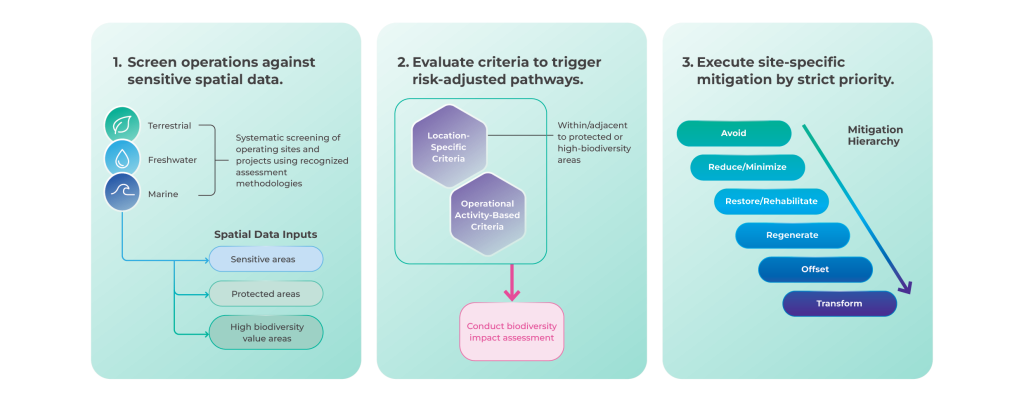
The Company assesses biodiversity-related dependencies, impacts, risks, and opportunities through a science-based process that covers all relevant activities across the full asset lifecycle. The process begins with initial screening to identify potential biodiversity impacts across our operations. Then, detailed biodiversity assessments are conducted by identifying interactions with terrestrial, freshwater, and marine ecosystems, using recognized assessment methodologies and spatial data on sensitive, protected, and high-biodiversity value areas.
Biodiversity impact assessments are conducted at all operating sites and projects under development. The assessments are evaluated against location-specific and operational activity-based criteria. These assessments include determining whether the sites are located within or adjacent to protected areas, key high-biodiversity wilderness areas, or other areas of high-biodiversity value. The results are integrated into the Company’s enterprise risk management framework and used to prioritize mitigation actions, inform site-specific biodiversity management plans, and drive continuous improvement in biodiversity performance.
Where impact is identified as significant, we conduct a biodiversity value assessment aligned with the Convention on Biological Diversity (CBD) framework. To avoid or mitigate the risks identified, site-specific biodiversity management plans (BMPs) are developed and implemented based on the mitigation hierarchy: avoid, reduce, restore/rehabilitate, regenerate, offset, and transform.

 English
  Thai
Thai